Video version of this article
0:09:27
Mountains, wind, driving, climbing, eating, jumping, talking, running, sleeping even... damn, this video has it all!
About Amnesia: https://www.youtube.com/watch?v=iHLMSEFfh8s
More about Amnesia: https://www.youtube.com/watch?v=0Qc8_UVd25s&list=PLV1Xd_...
About Skanþan, Yule & the Yew.
There are definitely no yew trees here though, so we better get moving. The yew tree, or "the common yew", that we have here in Europe, is a tree linked to the proto-Nordic deity Skanþan (Norse: Skaði). Skanþan was also known as ÎwaR (Norse: Ívarr). Both the name ÎwaR and the English word Yew comes from proto-Nordic root *îwa-, meaning "bow". Skanþan was the "hunter god" (later goddess), and the yew tree was the tree used to make the best bows. In fact, the yew gives the best wood for ALL wooden weapons, not just bows. Other trees were used only because they didn't have enough yew. Skanþan is barely mentioned in the mythology (the part that we still have, that survived Christianity). However, we have place names based on his names all over Scandinavia, and the name Scandinavia itself derives from proto-Nordic "Skanþinawjô", which means "Skanþan's land by the sea" or "Skanþan's islands". In other parts of Europe Skanþan was known as Devona (Slavic), Artemis (Greek), Arduinna (Celtic), Diana (Roman), et cetera. Some time between Classical Antiquity and the Viking Age, the god Skanþan changed gender, and became known as a goddess (Skaði), for unknown reasons. The same happened to his wife, the goddess NerþuR, who turned into a god (Njörðr).
The places named after Skanþan were near lakes and rivers, and east of them there was a hill or mountain, named after the Sun deity (most commonly "Solberg", meaning "Sun Mountain). When standing in the sacred places of Skanþan and looking to the east, you could see the sun rising in the morning. The sunlight coming from behind the Sun Mountain, was reflected from Skanþan's sacred source/lake/river in the morning. Scandinavia was populated by hunters, coming from what is today Denmark, when the glaciers retracted, after the last Ice Age. Yeah, in the original and strictest form, Scandinavia is made up of Norway and Sweden only, but we are basically all just Danes. Those who stayed in Norway/Sweden just didn't bother to return home to Denmark, after their hunting trips northward.
Well, let's cut the crap here and be honest: Norwegians are those Danes who got lost in the Norwegian mountains and failed to find their way back home. Thanks to gravity, the surviving flat-landers piled up in our fjords, and eventually became what we today call "Norwegians". Yeah. You don't learn that in school.
The Yew and Yule.
The kernels are extremely poisonous, but the tree "warns you" and in a sense tells you not to eat them, by giving them a very, very bitter taste. You can swallow the kernels whole, without chewing them, and if you do, a yew might well grow from your "droppings' if allowed to. It is better to just leave the kernels in "vinaigre' [vinegar (?)] over night, to simulate a "going-through-the-digestive-system-of-a-bird", and then plant the seeds. The yew tree grows very, very slowly, so don't expect it to grow large in a hurry.
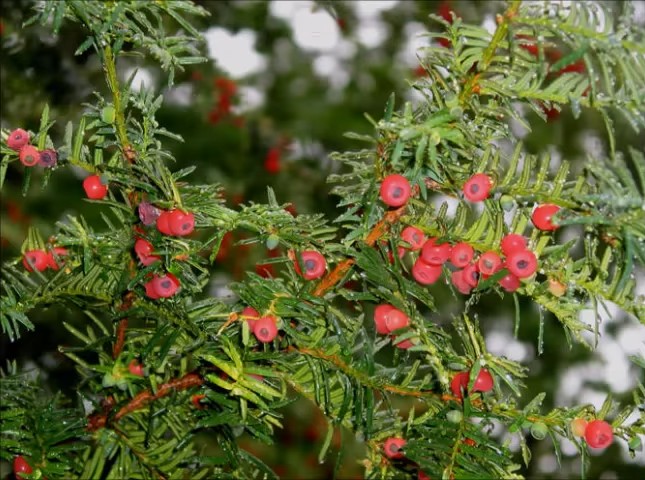
The yew was commonly planted on the burial mounds, because it was then nourished by the bodies of the dead, and because it can live "forever" and thus preserves the memory of the dead. The yew was the original "Yule Tree", and on the Yule Eve a twig of it was brought into the home to awaken the memories of the dead in the re-born, the returning dead. Due to the scarcity of the yew tree, it was eventually replaced by pine trees, which were decorated to look like yew trees, and thus served the same purpose: To awaken the memories of the long dead forebears. The gifts underneath the tree, are the same as those found in the burial mound: The valuables the forebear was buried with, and that are to be used to awaken the memories of his life in him, as he returns to life on the Yule Eve.
Yes. The custom of Yule (Christmas") are all very, very old, and are all related to our forebears well-founded belief in reincarnation and amnesia. The fact that the customs are still here, bears witness to just how Important they were to our forebears, AND HOW IMPORTANT THEY STILL ARE TO US TODAY! Have a Happy Yule and a Good New Year!
There are definitely no yew trees here though, so we better get moving. The yew tree, or "the common yew", that we have here in Europe, is a tree linked to the proto-Nordic deity Skanþan (Norse: Skaði). Skanþan was also known as ÎwaR (Norse: Ívarr). Both the name ÎwaR and the English word Yew comes from proto-Nordic root *îwa-, meaning "bow". Skanþan was the "hunter god" (later goddess), and the yew tree was the tree used to make the best bows. In fact, the yew gives the best wood for ALL wooden weapons, not just bows. Other trees were used only because they didn't have enough yew. Skanþan is barely mentioned in the mythology (the part that we still have, that survived Christianity). However, we have place names based on his names all over Scandinavia, and the name Scandinavia itself derives from proto-Nordic "Skanþinawjô", which means "Skanþan's land by the sea" or "Skanþan's islands". In other parts of Europe Skanþan was known as Devona (Slavic), Artemis (Greek), Arduinna (Celtic), Diana (Roman), et cetera. Some time between Classical Antiquity and the Viking Age, the god Skanþan changed gender, and became known as a goddess (Skaði), for unknown reasons. The same happened to his wife, the goddess NerþuR, who turned into a god (Njörðr).
The places named after Skanþan were near lakes and rivers, and east of them there was a hill or mountain, named after the Sun deity (most commonly "Solberg", meaning "Sun Mountain). When standing in the sacred places of Skanþan and looking to the east, you could see the sun rising in the morning. The sunlight coming from behind the Sun Mountain, was reflected from Skanþan's sacred source/lake/river in the morning. Scandinavia was populated by hunters, coming from what is today Denmark, when the glaciers retracted, after the last Ice Age. Yeah, in the original and strictest form, Scandinavia is made up of Norway and Sweden only, but we are basically all just Danes. Those who stayed in Norway/Sweden just didn't bother to return home to Denmark, after their hunting trips northward.
Well, let's cut the crap here and be honest: Norwegians are those Danes who got lost in the Norwegian mountains and failed to find their way back home. Thanks to gravity, the surviving flat-landers piled up in our fjords, and eventually became what we today call "Norwegians". Yeah. You don't learn that in school.
The Yew and Yule.
The kernels are extremely poisonous, but the tree "warns you" and in a sense tells you not to eat them, by giving them a very, very bitter taste. You can swallow the kernels whole, without chewing them, and if you do, a yew might well grow from your "droppings' if allowed to. It is better to just leave the kernels in "vinaigre' [vinegar (?)] over night, to simulate a "going-through-the-digestive-system-of-a-bird", and then plant the seeds. The yew tree grows very, very slowly, so don't expect it to grow large in a hurry.
The yew was commonly planted on the burial mounds, because it was then nourished by the bodies of the dead, and because it can live "forever" and thus preserves the memory of the dead. The yew was the original "Yule Tree", and on the Yule Eve a twig of it was brought into the home to awaken the memories of the dead in the re-born, the returning dead. Due to the scarcity of the yew tree, it was eventually replaced by pine trees, which were decorated to look like yew trees, and thus served the same purpose: To awaken the memories of the long dead forebears. The gifts underneath the tree, are the same as those found in the burial mound: The valuables the forebear was buried with, and that are to be used to awaken the memories of his life in him, as he returns to life on the Yule Eve.
Yes. The custom of Yule (Christmas") are all very, very old, and are all related to our forebears well-founded belief in reincarnation and amnesia. The fact that the customs are still here, bears witness to just how Important they were to our forebears, AND HOW IMPORTANT THEY STILL ARE TO US TODAY! Have a Happy Yule and a Good New Year!